Showing posts with label seniors. Show all posts

Monday, October 19, 2015

Car keys mean freedom, Taking away keys tough but ...

News - newsjournalonline.com
What You Need to Know

Taking the keys away from a parent or loved one with Alzheimer's, dementia or similar diseases can be difficult. Here are tips to make the task easier:

WARNING SIGNS

· They forget how to locate a familiar place and get lost.
· They fail to observe traffic signals and signs.
· They become angry and confused while driving.

HOW TO LIMIT DRIVING

· Ask a doctor to write a "do not drive" prescription.
· Have them tested by the Florida Department of Highway Safety and Motor Vehicles.
· Offer to drive or arrange other transportation.
· Have someone the person respects and trusts recommend they stop driving.
· Park the car on another block or in a neighbor's driveway.
· Hide the car keys or disable the car by removing the distributor cap or battery as a last resort.

BE PREPARED

· If the person wanders, he or she can get lost while driving, so register them in the Alzheimer's Association's Safe Return Program. Call 1-888-572-8566 or go online to alz.org and click on "medic alert + safety center" on the right-hand side of the home page.

SOURCE: Alzheimer's Association

Tuesday, October 13, 2015

Feel closer with voice and video calls

Free internet calls with Skype-to-Skype calls

Free calls It’s what Skype is made for.

Using Skype to call another person who also has Skype is totally free. Yep, absolutely nothing. Zip. Zero. Zilch

You’ve downloaded Skype, and so has your friend. Now you can get started on the really cool stuff – such as making completely free and great quality calls from your computer. That’s the great thing about Skype, you can use your internet connection and turn your computer into an internet phone and make free Skype-to-Skype calls.

You and your friend will need to have a headset (or use your computer’s built-in microphone and speakers) to talk to each other. You can really improve the sound quality of your calls with a headset, or take your calls to the next level with free video calls.

You can also use Skype to make terrific value calls to phones and mobiles.

Sunday, October 4, 2015

Pleasantries Adult Social Day Services

Pleasantries Adult Day Services - Home Page
Pleasantries is an Adult Social Day Services program located in a comfortable residential home at 195 Reservoir Street in Marlborough, Massachusetts.

Pleasantries has beautiful views where guests can enjoy nature by taking walks, fishing, gardening, and having a picnic with their peers.

Thursday, October 1, 2015

Moving Aging Family Member into Your Home .. sure?

Joy Loverde addressed Moving Aging Parents into Your Home on the EldercareABC Blog

Joy's information is applicable if you were to substitute "Aging Parents" with Brother, Sister, In law, Relative. What can start as a loving arrangement can turn very sour as we age and what was done on a handshake is hammered by fading memories, assumptions, and unforeseen changes in the needs of everyone.

Verbal contracts are bound to be regretted. After you read Joy's excellent article do not do anything until you have had a family meeting with a elder affairs attorney and review every point she raises. Then put the results in writing with signatures of the principles and your attorney. There is nothing so difficult as a house guest who comes to live in your home without a written agreements, who won't accept consequences of lifes changes, your health needs, your needing to relocate, selling your home and all the emotional, financial and other dynamics of living together.

Don't skip any of Joy's questions or suffer the consequences. They are available on line.

Dave Mainwaring.
--
Moving Aging Parents into Your Home Are you sure?
Sep. 17th, 2009 By Joy Loverde

"When times are tough, like they are now, sometimes well meaning caregivers of aging parents insist that their parents Moving aging parents, eldercare, senior helpmove in with them without full consideration of what can happen. The most serious stories include elder abuse and neglect, the fastest growing crime in America today. The arrangement of sharing one’s home with aging parents often stirs ambivalent feelings for everyone involved."

"We mean well when we ask our loved ones to move in with us; but we may not realize the potential negative consequences – emotionally, financially and otherwise. For example, if parents move in and contribute to the cost of remodeling the house to accommodate their needs, do they gift their portion of the house to the caregiving child? How do siblings feel about this financial arrangement? Should parents have a contract in which they pay the children for caring for them? How does this living arrangement affect a person’s eligibility for Medicaid?"

"I’d like every caregiver who is currently thinking about this under-one-roof lifestyle for them and their aging parents to take a deep, deep breath and proceed cautiously and slowly. If you have already exhausted the multitude of senior-housing options I offer in my book, The Complete Eldercare Planner, and you have made the decision that combining households is the best option, then promise me before anything else that you’ll take a family consensus as the final checklist before the move."
--
She is 1000% on target when she said:
The arrangement of sharing one’s home with aging parents is not for the faint at heart. If you succeed, you are beating the odds!

Dealing with Incontinence, products

Discover information and advice for caregivers of those with incontinence - TENA

What would you like to know about caring for someone with incontinence?

Understanding and discussing bladder weakness can be the first step to successfully managing it. So we’ve pulled together some useful information to help you and your loved one get incontinence into perspective and under control.

Product Finder

Loosing contact, personal letter is a thing of the past

The personal letter is quickly becoming a thing of the past - The Boston Globe
Last lines
As the longtime practice of writing personal letters by hand to family and friends is quickly becoming a thing of the past in the age of cellphones, text messaging, and e-mails, Globe writer Milton J. Valencia sat down and penned his own letter to the lost art.
By Milton J. Valencia
Globe Staff / September 20, 2009

Friday, September 18, 2015

Skype lets you talk and video conference over the Internet

"Enjoy the World, hobbies, crafts, creative pastimes, e-mail,web based Conversations, Blogs, Articles"
Skype is a little piece of software that lets you talk and video conference over the Internet with anyone, anywhere in the world for free while viewing each other on your computer screens.

This Listen-Zone describes one of several ways to set up and use Skype

Basic Requirements for Skype
# A high speed Internet connection
# a personal computer (Your computer must have Windows 2000, XP or Vista to run Skype)
# a webcam, a microphone (some web cams have a built in microphone) and speakers attached to your computer). Many lap-tops have built in speakers, some have built in webcam. If you are concerned with the audio being overheard you can use a headset with microphone
# first install the camera's software on your computer
# Then Connect the camera with the USB cable to any of the the computer's USB sockets (ports).
Many computers will automatically recognize that you plugged the webcam in and it will tell you there is a new device on the computer
# With the webcam connected you have also connected the microphone that is built into the webcam to the computer. You can now adjust the audio settings using the webcam controls or wait until you have installed Skype.
# The Logitech installer will guide you through the con figuration of the audio. You may download from the Logitech site or from Skype.
# Skype provides the software free of charge. After you have Skype installed they have additional services that you buy into.
# This article is limited to free services over the Internet to anyone, anywhere in the world for free while viewing each other on your computer screens.
# You will be asked to choose a Skype name
This the name or nickname that people will use to call you (connect with you) on using Skype. The Skype Setup Wizard will appear and guide you through the rest of the installation.
# Make certain peakers are plugged in and volume turned up. (or if using a head set plug it in)
# Now call the Skype Test service. It is an automated service that you call and it calls you back so that you know you are ready to Skype.
# Make your first call
Select your friend's Skype Name and press the big green call button.
# Sign up for a Google Account and for a Google gmail account

Wednesday, September 8, 2010

Caregivers Resources hundreds of links

Saturday, June 26, 2010

Fell On Floor and Can't Get Up, how to help

About Human Kinetics
Human Kinetics, mission is to produce innovative, informative products in all areas of physical activity that help people worldwide lead healthier, more active lives.

Human Kinetics is committed to providing quality informational and educational products in the physical activity and health fields that meet the needs of our diverse customers.
---
So you or your caring partner fell and is having trouble getting back up.

Here is an edited excerpt from Health Professionals’ Guide to Physical Management of Parkinson’s Disease
found on http://www.humankinetics.com/excerpts/excerpts/assisted-floor-transfer-techniques-for-patients-with-parkinsons-disease


"Assisted floor transfer techniques for patients with Parkinson's Disease
By Miriam P. Boelen, PT"

"Assisted Floor Transfer Techniques"

When the caregiver helps the patient up from the floor, both must be kept safe. If this is not possible, additional help such as a medical alert system may be needed. If possible, the gait belt should be snug for better leverage.

Transfers should be coordinated between the patient and caregiver to ensure simultaneous maximal effort and to minimize strain on both. The caregiver can accomplish this by giving instructions such as “On the count of three try rolling onto your hands and knees” or “On the count of three try to stand up.” Because of Parkinsonian symptoms, the patient may not initiate movement at the count of three.

The caregiver should be advised of this possibility so that she or he can delay giving assistance until the patient starts. Coordination of effort will avoid placing excessive strain on the caregiver. Caregivers should be encouraged to use optimal lifting body mechanics. .....

* Assisted side lying to hands-and-knees position. The optimal hand placement of the caregiver is to position one hand under the bottom hip and the other hand under the gait belt. The caregiver pulls up on the patient’s hips as if turning a big wheel (figure 11.6, a and b). The caregiver should flex the knees to facilitate lifting with the legs rather than the back.


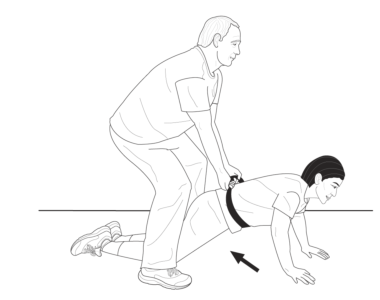
* Assisted prone to hands and knees. If the patient has strong arms, the caregiver (with proper body mechanics) can straddle the patient, grab the gait belt, and lean back while pulling up on the belt. At the same time the patient pushes with the arms (figure 11.7). As the patient walks her or his hands backward, the caregiver walks backward and guides the hips into the all-fours position.


* Assisted half kneeling to standing. The caregiver stands on the side of the patient that requires greater support. This positioning allows the patient to assist with his or her strongest side, which reduces difficulties in general. The caregiver places one hand on the gait belt and the other arm under the patient’s axilla (figure 11.8).

What to Do After a Fall

Patients often want to get up from the floor immediately after a fall. This desire may be due to the embarrassment of falling or their concern about their ability to get up. Sometimes patients do not think about the fact that after they have fallen, they cannot fall any farther and should be in no hurry to get up. Bystanders occasionally offer a helping hand, but their help may cause greater destabilization or irritate an already arthritic joint. Educating the patient about how to guide bystanders will help minimize these problems. Here are some general guidelines about what to tell your patient:

1. Do not try to get up right away.

2. Before attempting to get up, mentally note whether any areas feel injured. If you suspect injury, seek medical attention.

3. Attempt to relax for a moment before getting up.
.....

5. Before attempting to get up, someone should bring a chair close to you if needed so that you can use it for support to get up.

6. An additional chair could be placed behind you if you have difficulty turning. After you are standing, you can sit on the chair without having to turn.

This is an brief excerpt from Health Professionals’ Guide to Physical Management of Parkinson’s Disease. found on http://www.humankinetics.com/excerpts/excerpts/assisted-floor-transfer-techniques-for-patients-with-parkinsons-disease


----
A gait belt is a device used to transfer people from one position to another or from one thing to another. For example you would use a gait belt to move a patient from a standing position to a wheelchair. The gait belt is customarily made out of cotton webbing and a durable metal buckle on one end. The gait belt is worn around a patient's waist. The purpose for this is to put less strain on the back of the care giver and to provide support for the patient
--
Points to Remember: More than one caregiver may be needed. Belts with padded handles are easier to grip and increase security and control. Always transfer to resident's strongest side. Use good body mechanics and a rocking and pulling motion rather than lifting when using a belt. Belts may not be suitable for ambulation of heavy residents or residents with recent abdominal or back surgery, abdominal aneurysm, etc. Should not be used for lifting residents. Ensure belt is securely fastened and cannot be easily undone by the resident during transfer. Ensure a layer of clothing is between residents' skin and the belt to avoid abrasion. Keep resident as close as possible to caregiver during transfer. Lower bedrails, remove arms and foot rests from chairs, and other items that may obstruct the transfer

Tuesday, May 4, 2010

The number of unpaid family caregivers in the United States now tops 65 million

The Secret Caregivers

By Gail Sheehy, May & June 2010

Men care for their loved ones more often than we know. Why do they hide it? Inside their silent burdens and bittersweet rewards

The number of unpaid family caregivers in the United States now tops 65 million, involving more than three in ten households, according to "Caregiving in the U.S. 2009," a report conducted by the National Alliance for Caregiving (NAC) in collaboration with AARP, and funded by the MetLife Foundation. Despite a common stereotype that caregiving is women's work, one third of American caregivers are men, the report reveals.


Monday, May 3, 2010

How to make a visit to the physician easier for AD patient.

Pleasantries Adult Day Services - Marlboro, Massachusetts - Alternative Alzheimer’s care
Tammy Pozerycki
Owner & Director

Writes in a
Pleasantries A.D.S. newsletter:
It is important that your loved one with Alzheimer's disease have regular visits to his or her physician. These visits should address all medical and behavioral issues which may be related to Alzheimer's disease. In order to experience a productive appointment with the physician, try the following suggestions:

* Choose a "good" time of day for the appointment time (most likely morning will be best.)

* Bring along an activity that your loved one enjoys (books, sorting activity, coloring, etc) as well as a snack and water. This will prepare you for an unexpected wait time.

* Bring a list of all medication including over-the-counter. Create a list of questions in preparation of the minimal time available with the doctor.

* Depending on your situation, it may be helpful to bring someone else with you, such as a close friend or family member.

* Discuss what you can expect for the future and advance directives.

* It is good to take notes as there will be much discussed in a short amount of time.

* Be open and honest. If you are not happy or satisfied with the physician, make he or she aware of your concerns. Switching physicians can be confusing to your loved one and possibly detrimental in the longrun. If discussed, the issues may be resolved.


Monday, February 1, 2010

Raise your hand if you're a caregiver.

How Can Doctors and Caregivers Work Together?

from: HealthBridge's In-Home Care Blog

Dr. Pauline Chen took an insightful look at this topic in her "Doctor and Patient" column in the New York Times. She writes:

For all our assertions about the importance of caring in what we do, doctors as a profession have been slow to recognize family members and loved ones who care for patients at home. These “family caregivers” do work that is complex, physically challenging and critical to a patient’s overall well-being, like dressing wounds, dispensing medication, and feeding, bathing and dressing those who can no longer do so themselves.

Many of these caregiving tasks were once the purview of doctors and nurses, a central component of the “caring professions.” But over the past century, as these duties increasingly fell to individuals with little or no training, doctors and even some nurses began to confer less importance, and status, to the work of caregiving.


nightmare for those with disabilities who are struggling to stay at home.

http://www.kaiserhealthnews.org/Columns/2010/February/020110Gleckman.aspx

Feb 01, 2010


There are programs run by states and similar projects run out of Washington. This is a particular nightmare for those with disabilities who are struggling to stay at home. If you don’t believe me, try to find a local phone number for elder care assistance.


Monday, December 14, 2009

Death Panels, Alaska | Sarah's "Palin Care For Seniors" Worked Even Better than Death Squads

Why Use Death Squads In Alaska When Sarah Palin Had Palin Care For Seniors That Worked Even Better?
"Sarah Palin is worried about Death Panels but many Alaskans are worried about Palin Care. During her tenure from 2006-2009, 277 elderly died from the poor management under her command! The Anchorage Daily News reported about this story last July, the situation in the state’s Medicare and Medicaid funded in-home elder care program became so bad that the federal government had to step in and force Palin to make the necessary improvements."
"In one 2 1/2 year stretch, 227 adults already getting services died while waiting for a nurse to reassess their needs. Another 27 died waiting for their initial assessment, to see if they qualified for help."

http://ow.ly/169ijf


Monday, November 30, 2009

Saturday, October 24, 2009

The Diabetes Health Care Crisis

http://oregoneldercareservices.com/?p=712
The Diabetes Health Care Crisis
People with Diabetes Don't Have Access to Adequate and Affordable Health Care

* Health insurance policies don't cover basic diabetes needs and reward crisis care, not the continuous care needed to prevent a medical crisis.
* Pre-existing condition exclusions prevent people from enrolling.
* Health insurance premium surcharges for diabetes drive premiums above what individuals and small businesses can afford.
* Medicaid eligibility limits leave many low income people unable to access health insurance.

Health Insurance Options 65 and Above


The following options may be available to you.

Medicare
Medicare provides health insurance benefits to persons 65 and older, persons under 65 who are disabled, and individuals with End Stage Renal Disease (ESRD).

Medicaid
Medicaid provides medical care to certain individuals and families with low incomes and resources.

TAA Tax Credit
TAA is a tax credit available to workers who have lost their jobs or whose hours of work and wages have decreased as a result of increased imports.

Prescription Assistance
Most pharmaceutical companies have established patient assistance programs to help uninsured individuals get the medications that they need to stay healthy.

Medigap
Medigap policies are available to Medicare-eligible individuals. They can be purchased from private health insurance carriers and provide benefits that are otherwise not included in Medicare Part A or B

Additional Resources:


Sharing bad news with an aging parent

http://oregoneldercareservices.com/?p=712
Crucial Conversations
So, here’s the big question. What can you do to make handing in his car keys something your father wants to do? Or something he is at least willing to tolerate?

Answer: Don’t equate taking away the keys with helplessness, boredom, and the complete loss of independence.

Kerry Patterson is author of three bestselling books, Influencer, Crucial Conversations, and Crucial Confrontations. Read the rest of his answer to this very important question here. http://ow.ly/15X2Vp


Thursday, October 22, 2009

Visit Fifty-Plus Zone | http://www.listenzone.com/

Are you exploring living concepts-options, residence options, adult routine care, assistance, and access to services, avoiding admission to nursing homes or assisted living facilities, finding autonomy, individuality, social relationships and dignity? Everyone wants to avoid loneliness, helplessness and boredom.

"Enjoy the World, hobbies, crafts, creative pastimes, e-mail,web based Conversations, Blogs, Articles"
The Retirement Community website has a extensive directory of subjects retirees will want to browse: Active Adult Communities, Adult Day Services, Assisted Living, Alzheimers Care, Continuing Care, Home Care and Hospice Care, Independent Living, Senior Centers, Choosing a Retirement Community, Driver's Licensing, Medicaid Regulations by State, Property Taxes By State, Retirement Glossary, State Elder Affairs Agencies, Taxes By State, and Types-of-Senior-Housing.

Thursday, October 15, 2009

Mass. Medicaid program has no job requirements for personal care attendants.

Home-care system leaves elderly at risk, auditor says - The Boston Globe
By David Abel
Globe Staff / October 15, 2009

Massachusetts state program that oversees home health care services for about 18,000 elderly and disabled residents is vulnerable to fraud and has employed personal care attendants who have committed felonies, including manslaughter, assault, and threatening to commit murder, according to a report released yesterday by the Office of the State Auditor.

The report also noted that the Mass. Medicaid program is one of only four out of 238 programs nationwide with no job requirements for personal care attendants.

The audit drew criticism from state health officials because it surveyed only 30 patients, whose cases had been previously reviewed for fraud by the federal government.

But State Auditor A. Joseph DeNucci said the findings illustrate why the state should establish job requirements for attendants, including training, education, and criminal background checks, which nearly every other program in the country requires.

“What we have found is that there are serious problems in the program,’’ DeNucci said in a phone interview. “We have to strengthen protections for vulnerable people. I think it’s very important.’’

The report also found that 14 of the 30 patients had hired attendants who either had been convicted of a felony or a court had found sufficient evidence to find them guilty. Of the 82 attendants who worked for the 30 patients between 2004 and 2008, seven had been in prison, 12 were involved in violent crimes, nine had been convicted of drug offenses, 10 committed robbery, nine had restraining orders against them, and four had outstanding warrants.

In all, auditors found 41 acts of violence, 29 crimes of theft, and 26 drug crimes, including heroin distribution and trafficking cocaine in a school zone.

State Representative Barbara L’Italien, an Andover Democrat and former attendant, introduced a bill this year that would allow patients to run a free criminal background check on attendants they hire, create an online database to help consumers find attendants, and establish a surrogate program to help those who cannot oversee attendants on their own. The bill has yet to emerge from committee.

“David Abel can be reached at dabel@globe.com.

Tuesday, October 13, 2009

Senior Centers and Adult Day Care activities

Browsing the Web to see what many adult day care programs and Senior Centers were offering. I found the following:

Active floor and table games
Art Therapy,
Arts
Bingo
Card Games
Chair exercises
Chorus & Music Therapy
Cooking
crafts,
Daily Exercise
Discussion groups (books, films, current events)
Discussions: contemporary and devotional
Entertainment
Exercise classes personalized for individual levels of activity and ability.
Gardening
Group discussions on a wide range of subjects
Guest speakers from community organizations
Health awareness talks
health monitoring by a nurse to meet individual needs. There is a
Holiday and birthday celebrations
Horticultural Therapy
individual counseling,
Inter-generational Programs
Kosher Lunch
Local outings.
Mental stimulation games such as BINGO
miniature golf course on site
Music
Musical entertainment and sing-a-longs
nutrition education,
Nutritional Snacks
meals and snacks individualized for specific dietary needs.
field trips,
On Site Library
Organized games of bridge, bingo, cards and trivia,team events
personal care,
Pet Therapy
podiatry care,
Poetry Class
Pottery
quiet rooms with rest areas and television
recreational classes,
Relaxation time
Reminiscing
Spiritual Program
Stretching or other gentle exercise
Student Interns
Tai Chi Class
Talking about current events
Transportation
Volunteers
Weight Loss Club
Woodworking Shop